bf1e605e32056b8a9f2eff03000bf66e.tmb-hero-image.jpg?Culture=en&sfvrsn=721b0bba_1 "Bearded man enjoying an outdoor barbecue with a drink in hand, standing next to a grill on a sunny day, creating a relaxed backyard gathering vibe")
MEET THE AGENCY
Inside Story
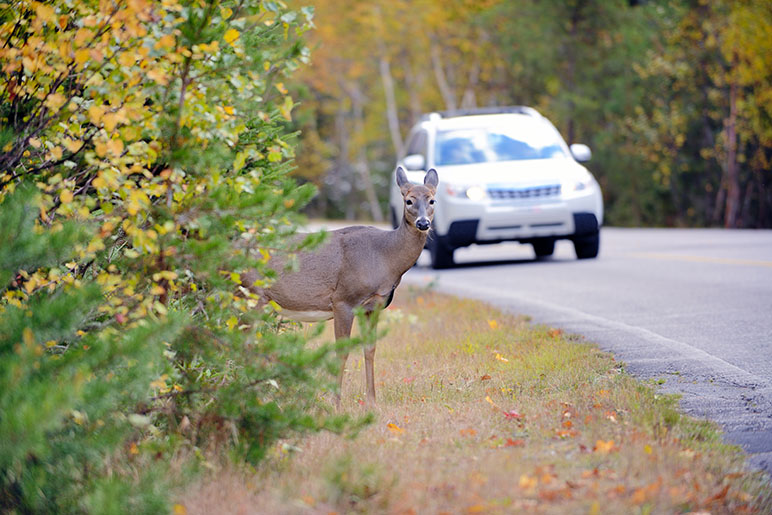
Quick answer: Yes. Unless you have a liability-only policy, hitting a deer is covered by your Other Than Collision (comprehensive) coverage at Indiana Farm Bureau Insurance. And at Indiana Farm Bureau Insurance, a deer strike claim will not automatically increase your premium. If your vehicle is damaged after hitting a deer, file a claim online, on our mobile app or call 800-723-3276.
You're driving home on a two-lane, rural road in Indiana just before dusk. A flash of brown bolts from the tree line. You hear the thud before you can react. Your bumper is cracked, the hood is dented and one headlight is gone.
According to the Indiana Department of Natural Resources, more than 14,000 vehicle-deer collisions are reported in Indiana every year. If it happens to you, know that your insurance likely covers it unless you have a liability-only policy. If you have an Indiana Farm Bureau Insurance auto policy with Other Than Collision coverage, hitting a deer won't automatically result in a rate increase.
This is the part that confuses many drivers. The answer depends on what your vehicle actually hit:
What Happened | Coverage That Applies* | Why |
You hit a deer | Other Than Collision (Comprehensive) | The deer is a moving animal, not a stationary object you collided with |
You swerve to avoid a deer and hit a tree, guardrail or ditch | Collision | You collided with a stationary object, even though a deer caused you to swerve |
You swerve to avoid a deer and hit another vehicle | Collision + Liability | A collision with another vehicle, plus potential liability for the other driver's damages |
This distinction matters because different coverages have different deductibles, and the type of claim may affect your claims history differently. At Indiana Farm Bureau Insurance, Other Than Collision coverage handles deer strikes, and a deer strike claim will not automatically raise your premium.
If you only carry liability insurance (Indiana's minimum 25/50/25), you would not likely have coverage for damage to your own vehicle in any of these scenarios. You'd need Other Than Collision or Collision coverage on your policy.
The moments after hitting a deer can be disorienting. Following these steps after the accident can help you stay safe and set up your claim properly:
Turn on your hazard lights and pull over safely. If your vehicle is drivable, move to the shoulder. If not, assess your surroundings: you may need to stay in the vehicle with your seatbelt on and hazards flashing, or exit and move off the roadway depending on traffic and visibility.
Stay away from the deer. An injured deer can kick and cause serious injury. Do not approach it or try to move it. Remain in your vehicle or maintain a safe distance.
Call the police. Report the incident and request an officer to come to the scene. A police report creates an official record that supports your insurance claim.
Document the damage. Once it's safe, take photos of your vehicle damage, the road, the deer (from a safe distance), and the surrounding area. Note the date, time and exact location.
Check if your vehicle is drivable. If it's not, call for a tow. If you have roadside assistance on your policy, use it.
File your claim. You can file a claim online through your Indiana Farm Bureau Insurance account, on our mobile app or by calling 800-723-3276. Have your policy number, the police report information and your photos ready.
Indiana's deer population is large and active year-round, but certain times and places carry higher risk:
Dawn and dusk. Deer are most active during the low-light hours of early morning (5-8 a.m.) and evening (5-8 p.m.). These overlap with commuting hours, which is why so many collisions happen on the way to or from work.
October through December. This is the peak season for deer movement. Harvest activity pushes deer out of their normal patterns, and the fall mating season (the "rut") makes bucks less cautious than usual.
Near cornfields and wooded areas. Deer feed in agricultural fields and take cover in tree lines. Rural roads that run between open fields and woods are especially high-risk zones.
Multi-lane highways near wooded corridors. Even urban and suburban drivers aren't immune to potential deer strikes. Deer regularly cross highways and bypasses, especially where green space borders the road.
Use high-beam headlights at night on rural roads (when no oncoming traffic is present) for maximum visibility.
Watch for deer crossing signs. These signs are placed in areas with documented deer activity.
Reduce your speed in high-risk areas, especially at dawn and dusk from October through December.
If a deer runs in front of your vehicle, brake firmly but try not to swerve. Swerving into oncoming traffic or off the road often causes more serious damage (and possible injury) than hitting the deer.
Wear your seatbelt, always. A deer strike at highway speed can cause significant vehicle damage and occupant injury.
At Indiana Farm Bureau Insurance, not automatically. If you have Other Than Collision coverage, a deer strike is not considered an at-fault accident. Your premium will not automatically increase as a result of filing a deer collision claim.
This isn't the case with every insurance company, so if you're insured elsewhere, check with your insurance company. It's one of the reasons knowing your coverage matters.
Nobody wants to hit an animal. If it happens to you, it's normal to feel shaken, guilty or upset. More than 14,000 Indiana drivers deal with this every year. You're not the first, and you won't be the last.
Your safety and the safety of your passengers matter most. Focus on the immediate steps of pulling over, calling for help, documenting and filing claim)
Not sure if you have the right coverage?
Your local Indiana Farm Bureau Insurance agent can review your auto policy and help make sure you have Other Than Collision coverage in place before deer season arrives.
Hitting a deer is likely covered by comprehensive (Other Than Collision) coverage. If you swerve to avoid a deer and hit a tree, guardrail, or another vehicle, that's typically a collision claim. The distinction depends on what your vehicle actually struck and your auto coverages.
At Indiana Farm Bureau Insurance, no. A deer strike claim will not automatically increase your premium if you have Other Than Collision coverage. Policies vary by insurer, so if you're insured with another company, check with them directly.
It's not necessarily illegal to drive away after hitting a deer, but reporting the incident is strongly recommended especially if the deer remains in the roadway or poses a hazard to other drivers. If anyone is injured during the collision, you are legally required to report it to law enforcement. A police report also helps support your insurance claim.
Depending on the situation, you may need to turn on your hazard lights and stay in your vehicle, or you may need to exit and move off the roadway to a safe place. You also may need to call the police or a towing service. If your Indiana Farm Bureau Insurance policy includes roadside assistance, call 800-723-3276 for assistance. Do not attempt to move the deer or walk along the roadway in the dark.
Very common. The Indiana Department of Natural Resources reports more than 14,000 vehicle-deer collisions in the state each year. Peak season runs from October through December, with the highest risk at dawn and dusk.
Costs vary widely depending on the speed of impact and the area of the vehicle that's damaged. Nationally, and depending on the vehicle, an average deer collision claim may total several thousand dollars. Major impacts where airbags deploy or the frame is damaged can be even more costly. Your Other Than Collision coverage typically pays for repairs after your deductible depending on your auto coverages. (Related: Does a windshield claim raise car insurance rates in Indiana?)
Contact Us

*Securities & services offered through registered representatives of FBL Marketing Services, LLC, 225 South East Street, Indianapolis, IN 46202, 317-692-7628, Member SIPC. FBL Marketing Services, LLC, is not affiliated with Indiana Farm Bureau, Inc. or United Farm Family Life Insurance Company.
© 2026 Indiana Farm Bureau Insurance. All Rights Reserved. Farm Bureau, FB, and
the national Farm Bureau logo are trademarks of the American Farm Bureau Federation.


